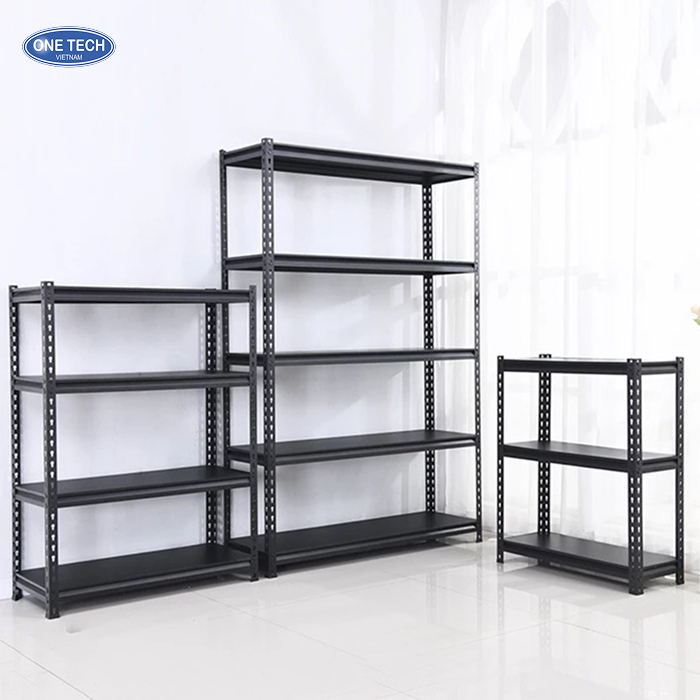
Medium-duty rack is a suitable storage solution for small and medium-sized warehouses, parts warehouses, component warehouses, material warehouses, and e-commerce warehouses. With common load capacities ranging from 200 to 700 kg per level, this type of rack optimizes storage space, organizes goods scientifically, and facilitates convenient import and export processes. One Tech Rack offers various models of medium-duty rack with 3, 4, 5, and 6 levels, custom-made to the specific dimensions and needs of each warehouse.
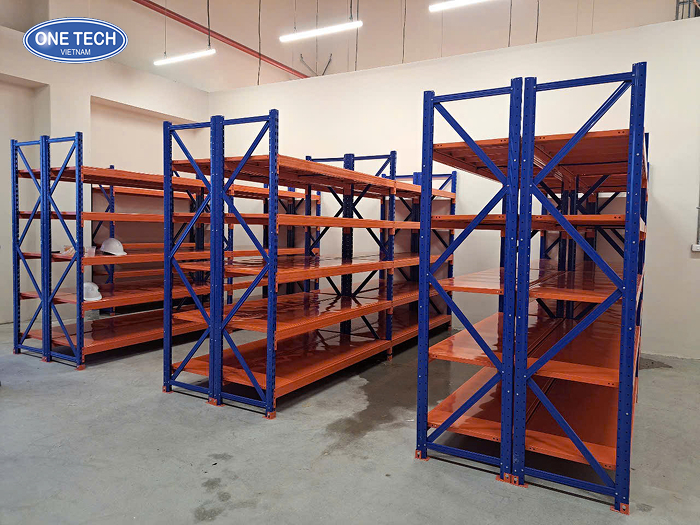
1. What is medium-duty rack?
Medium-duty rack is a type of warehouse rack specifically designed for storing goods with medium load capacities. It typically features multiple levels to optimize warehouse height and facilitate more efficient goods classification. This type of rack is suitable for warehouses where manual loading and unloading is required, unlike heavy-duty industrial rack systems that do not necessitate the use of forklifts.
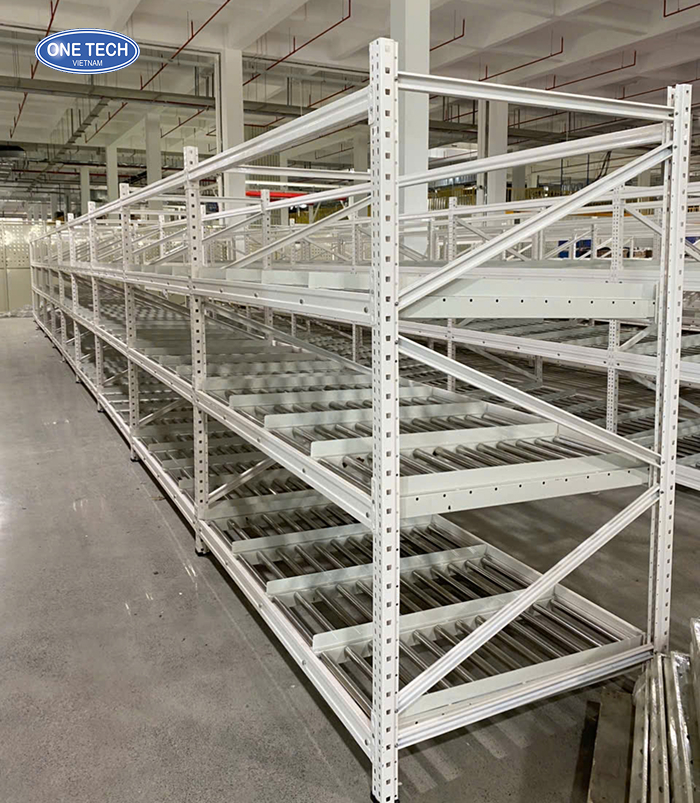
In practice, medium-duty warehouse rack is commonly used for storing cardboard boxes, mechanical parts, electronic components, technical supplies, documents, e-commerce goods, or product groups that need to be stored on separate levels. A major advantage of this type of rack is its ease of assembly and disassembly, flexible adjustment of shelf spacing, and the ability to be custom-made to fit the actual warehouse layout.
2. Medium-duty rack models offered by One Tech Rack
To suit various warehouse models, One Tech racking offers a wide range of medium-duty racking systems with different numbers of tiers, load capacities, shelf types, and installation configurations. Depending on the type of goods, warehouse height, and access methods, customers can choose from the popular models below:
- 3-tier medium-duty rack
- 4-tier medium-duty rack
- 5-tier medium-duty rack
- 6-tier medium-duty rack
- Medium-duty rack with sheet metal, plywood, and mesh surfaces.
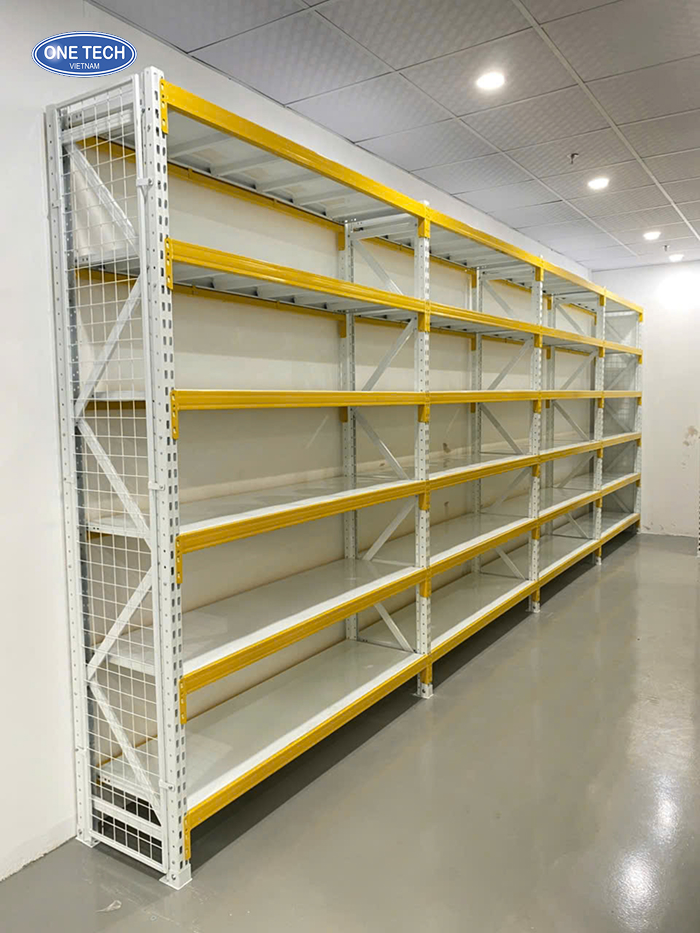
Freestanding medium-duty rack and interconnected rack.
To optimize costs and space, medium-duty rack can be assembled as standalone units or in a continuous series of bays. The continuous configuration saves on uprights, makes good use of floor space, and allows for convenient expansion as storage needs increase in the future.
In addition to the popular models above, One Tech rack also accepts custom orders for medium-duty warehouse rack based on floor space dimensions, cargo load capacity, desired number of levels, and the actual operation of each warehouse.
3. Specifications for medium-duty rack
One Tech’s medium-duty rack is manufactured in various sizes to suit different warehouse types. According to One Tech’s specifications, this rack system is typically deployed in a common load capacity range of 200-700kg/shelf , in addition to some custom configurations that can be fabricated to meet specific requirements. Below are some common reference parameters when choosing medium-duty warehouse rack :
| Parameter | Reference value |
| Shelf height | 1,500 – 4,000mm or custom-made to order. |
| Length of each compartment | 1.500 / 2.000 / 2.500 / 3.000mm |
| Shelf depth | 400 / 500 / 600 / 800 / 1.000 / 1.200mm |
| Number of floors | 2 floors / 3 floors / 4 floors / 5 floors / 6 floors |
| Load per floor | Typically holds 200–700 kg per shelf, depending on configuration and storage needs. |
| Frame material | Powder-coated steel, Omega-shaped leg structure and load-bearing beam. |
| Floor surface | Sheet metal tray / MDF board / steel mesh |
| Popular colors | Green-orange, gray-orange, or as requested. |
| Pickup method | Pick up goods by hand, with a ladder truck, or with a trolley. |
| Installation type | Freestanding shelving / modular shelving / warehouse layout design |
4. Structure of medium-duty rack
A standard medium-duty racking system typically consists of the following five main component groups. Each component directly affects the load-bearing capacity, stability, and lifespan of the entire racking system:
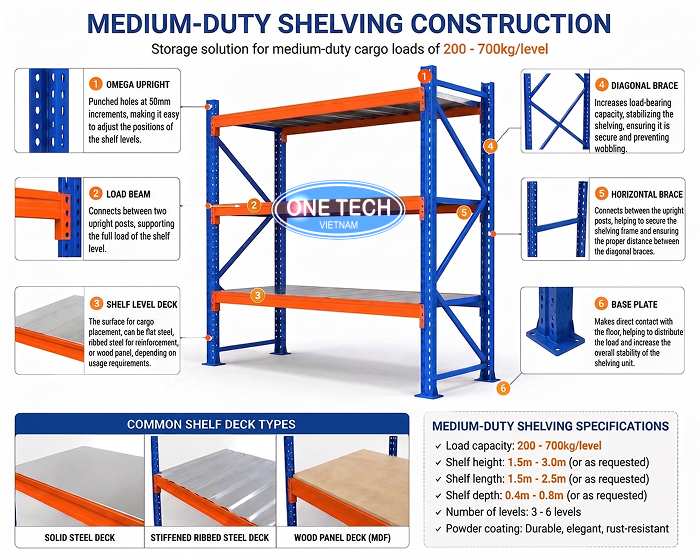
Key features of medium-duty rack systems:
- The distance between shelves can be flexibly adjusted according to the actual height of the goods.
- The rack system is sturdy and suitable for a wide variety of goods with medium load capacity in the warehouse.
- Easy to disassemble, expand, or change the layout when a storage system upgrade is needed.
- Various shelf types are available to suit dry goods, canned goods, parts, or components.
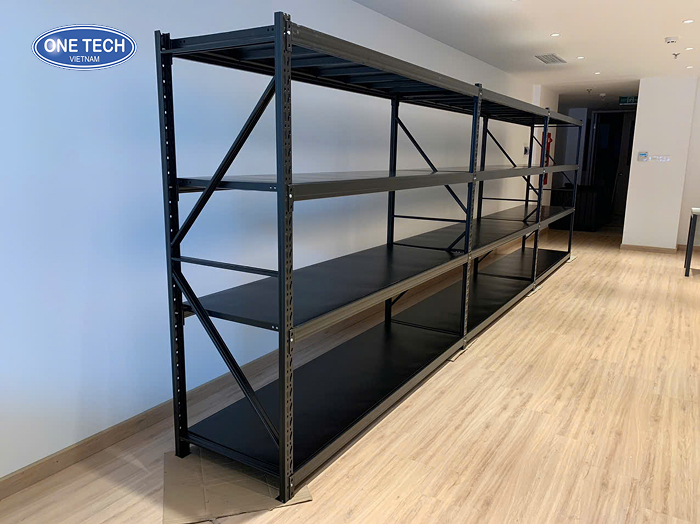
Compared to storing goods directly on the floor, medium-duty warehouse racking systems allow for clear stratification of goods, reduce mold and mildew, facilitate easier inventory management, and support more efficient warehouse operations as the number of product codes increases. For warehouses requiring pallet storage or heavier loads, customers can consider heavy-duty racking systems for a more suitable solution.
5. What types of warehouses are medium-duty rack suitable for?
Thanks to its good load-bearing capacity, flexible configuration, and reasonable investment cost, medium-duty rack is used in many different warehouse models. Depending on the type of goods and operation, this type of rack can be applied to:
- Warehouse for mechanical parts, motorcycle and car parts, and technical components.
- Warehouse for electronic components, warehouse for production materials, warehouse for packaging.
- E-commerce warehouse, order packing warehouse, online shop warehouse.
- File and document storage, stationery storage, internal archives.
- Consumer goods warehouses, wholesale store warehouses, or small distribution centers.
- Cool storage, cold storage, or environments requiring ventilation should use a suitable mesh panel configuration.
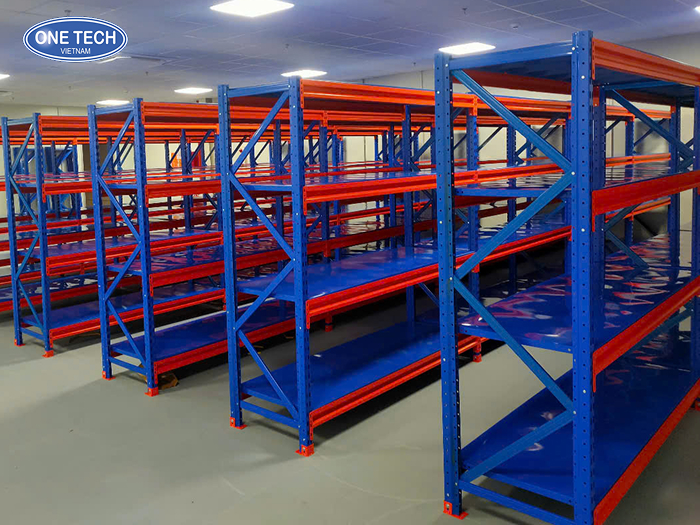
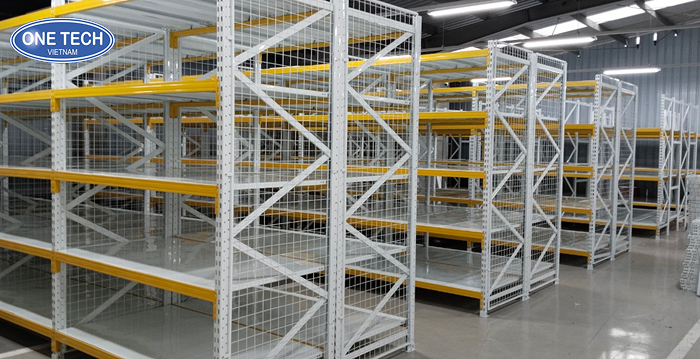
In practice, medium-duty steel rack is particularly suitable for warehouses that require manual handling, have a moderate number of product codes, and do not require the use of pallet forklifts like heavy-duty rack systems . This is a balanced option between load capacity, flexibility, and investment cost for many small and medium-sized businesses.