
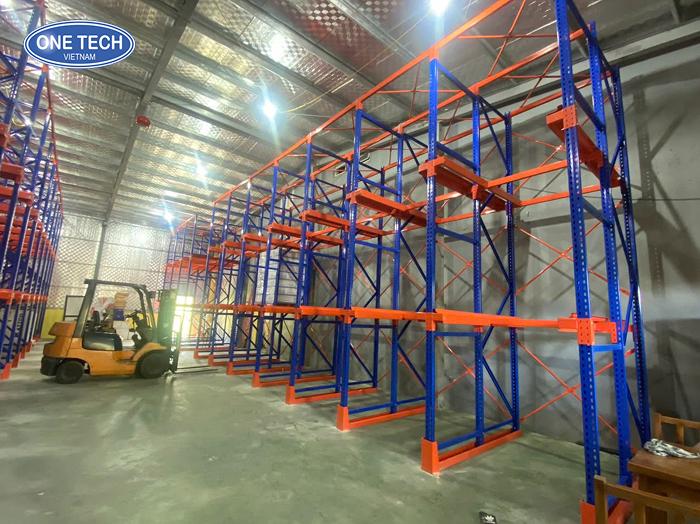
Industrial warehouse racking is more than just a place to store goods off the floor. In a continuously operating factory, the racking system directly affects storage capacity, inbound and outbound operations, aisle layout, and inventory control. Choosing the right racking system from the beginning allows businesses to maximize their existing space without having to constantly redesign the warehouse as operations expand.
1. Key features of industrial warehouse racking systems
A warehouse racking system should be designed based on the actual goods and operating processes rather than relying solely on the available floor area. Several factors should be determined before designing the system:
- Suitable load capacity: The weight of goods stored on each level or pallet must be accurately determined to select the appropriate upright frames, beams, and number of storage levels.
- Product dimensions: The width, depth, height, and packaging specifications of goods determine the required rack dimensions and clearance for lo ading and unloading.
- Effective use of vertical space: For factories with high ceilings, vertical storage allows businesses to increase capacity without expanding the building footprint.
- Compatibility with material-handling equipment: If forklifts are used, rack height, aisle width, and load capacity should be designed according to the type of forklift operating in the warehouse.
- Easy inventory management and handling: Fast-moving products should be placed in easily accessible positions, while slow-moving goods can be stored in high-density systems.
- Safe operation: Racking systems must have stable structures, suitable anchoring, and sufficient clearance from forklifts, aisles, and production areas.
2. Common smart warehouse racking systems for factories
Mezzanine flooring systems for expanding factory space
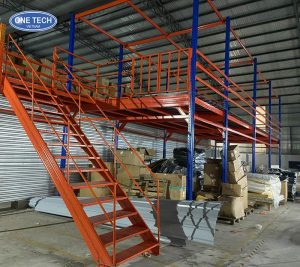
Mezzanine flooring systems are suitable for factories with high ceilings but limited floor space. Instead of constructing additional permanent concrete floors, the system creates one or more elevated working or storage levels above the existing floor.
The space underneath can continue to be used for production, storage, or packaging, while the upper level can accommodate goods, components, documents, or other operations requiring additional space. The system can also be integrated with staircases, guardrails, steel flooring, and goods-lifting areas to create a complete multi-level working environment.
Medium-duty racking – 200–700 kg per level
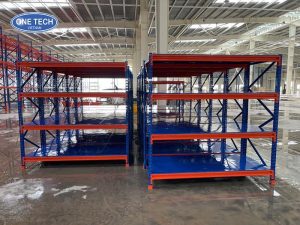
The main advantage of medium-duty racking is its flexible shelf adjustment. When carton sizes or storage requirements change, the height of each level can be adjusted to minimize unused space.
For factories with multiple SKUs where individual items are not excessively heavy, medium-duty racking provides an organized storage solution that is easy to divide into sections and manage without requiring specialized pallet-handling equipment.
Selective pallet racking
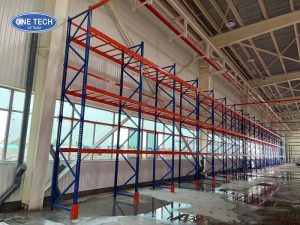
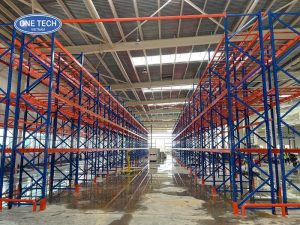
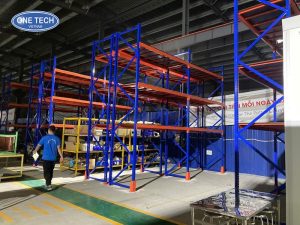
Selective racking is designed for warehouses that use pallets and require direct access to individual storage positions. Each pallet is stored in a dedicated location, making it convenient to retrieve, replenish, or inspect a specific product.
The system is particularly suitable for factories with multiple SKUs and frequent inbound and outbound operations. Forklifts can access each pallet independently without moving other pallets, making it easier to manage inventory by product code, batch, or storage area.
Double deep racking for higher storage density
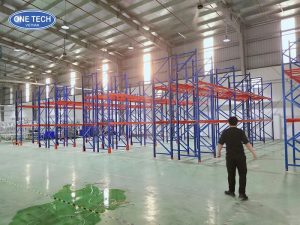
When a warehouse handles a large number of pallets but does not require frequent direct access to every pallet, Double Deep racking can be considered.
The system places two pallet positions deep, reducing the number of aisles required compared with conventional Selective racking. As a result, businesses can increase the number of pallet storage positions within the same floor area.
Roller racking for product flow
Unlike racking systems primarily designed for static storage, roller racking allows goods to move along roller tracks. It is suitable for factories where inbound, outbound, or internal material flow follows a relatively defined sequence.
Goods can be loaded from one end and move toward the other, reducing manual handling between storage positions. This makes roller racking particularly useful for buffer storage, finished goods warehouses, packaging areas, and production lines requiring a continuous supply of materials.
Drive-in racking for forklift access
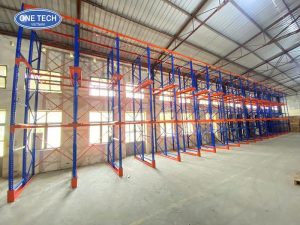
Drive-In racking allows forklifts to enter directly into the rack structure to load and retrieve pallets. By eliminating most aisles between individual rack rows, the system provides high storage density within a limited floor area.
It is particularly suitable for factories storing large quantities of the same product or groups of goods with similar specifications, especially when storage capacity is prioritized over independent access to each pallet.
3. One Tech – Industrial warehouse racking design and supply
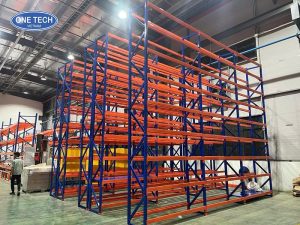
For factory warehouses, One Tech approaches each project based on the actual floor plan, stored goods, and operating processes rather than simply providing a standard quotation for individual rack units. Information such as load capacity, product dimensions, pallet specifications, warehouse height, and forklift type is taken into account to develop a suitable racking solution.
Businesses can choose individual racking systems or combine multiple solutions within the same warehouse. For example, pallet storage areas can use Selective or Double Deep racking; boxed raw materials can be stored on medium-duty racks; while areas requiring additional floor space can be equipped with Mezzanine systems. This approach allows each racking system to perform its intended function instead of forcing the entire factory to operate under a single storage model.
One Tech provides a complete solution from consultation and design to manufacturing, transportation, and installation, helping businesses implement warehouse racking systems based on their actual site conditions. As warehouse operations expand, the racking layout can also be reviewed and adjusted to meet new storage requirements.
An efficient factory does not necessarily need the largest possible number of warehouse racks. What matters is having the right type of racking in the right location. Loose goods, palletized products, fast-moving inventory, and high-density storage each have different requirements.