
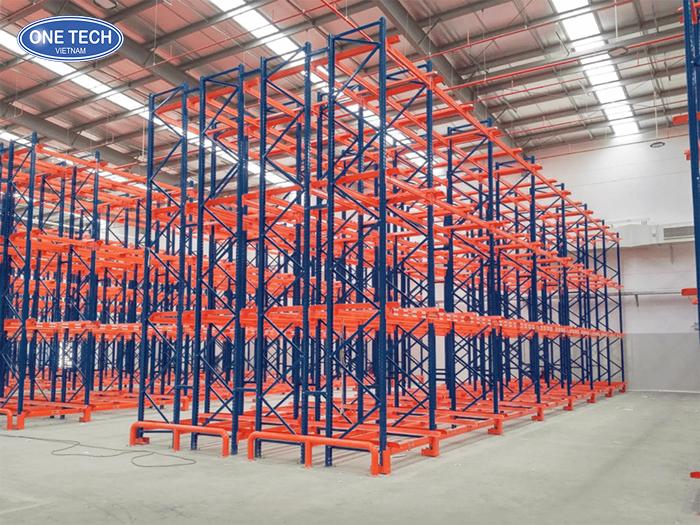
Electronics warehouses often need to store large quantities of components, devices, and finished products across a wide range of SKUs. These products are typically high-value, require proper storage conditions, and often have relatively short technology life cycles. Double Deep rack for electronics warehouses is a solution worth considering for businesses looking to increase pallet storage density while maintaining relatively flexible access to inventory.
1. What is Double Deep rack? What is its structure?
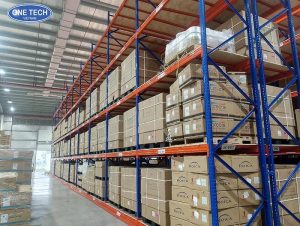
Double Deep rack is a pallet rack system designed to store two pallets deep in a single storage position, typically created by placing two rows of Selective rack back-to-back.
Unlike Selective rack, which allows pallets to be loaded into only one position in depth, Double Deep rack makes use of the space behind the first pallet. This reduces the number of forklift aisles and increases overall storage density.
A typical Double Deep rack system consists of:
- Omega upright frames: The main load-bearing components that connect the rack levels and transfer the load down to the warehouse floor.
- Beams: Support the pallets and connect to the upright frames through locking connectors.
- Bracing: Improve the stability and load-bearing capacity of the rack frames.
- Pallet support rails or bars: Help keep pallets securely positioned on each rack level.
- Column protectors: Reduce the risk of damage caused by forklift impacts during warehouse operations.
2. Standard technical specifications of Double Deep rack
Double Deep rack does not have one fixed size for every warehouse. The system should be designed according to pallet dimensions, product characteristics, warehouse height, and the type of forklift being used.
|
Item |
Reference specifications |
|
Load capacity |
Approximately 500–5,000 kg/level or according to design requirements |
|
Height |
Approximately 2–10 m, depending on warehouse height |
|
Depth |
Designed to accommodate 2 pallets in depth |
|
Beam length |
Based on pallet dimensions and the number of pallets per level |
|
Number of levels |
Adjustable according to warehouse height |
|
Pallet types |
Wooden, plastic, or steel pallets |
|
Lifting equipment |
Typically Reach Trucks |
|
Storage/retrieval method |
Primarily LIFO |
The specifications above are for reference only. For electronics warehouses, the rack system should be engineered based on the actual load per pallet, pallet dimensions, product height, and the required safety clearance for forklift operations.
3. Why is Double Deep rack an optimal choice for electronics warehouses?
Optimize storage capacity by 30%–40%
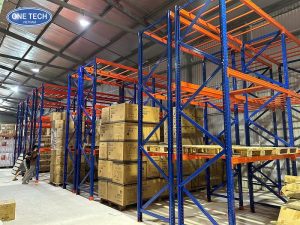
Double Deep rack reduces the amount of floor space required for forklift aisles, allowing businesses to maximize warehouse height and available space to store large quantities of components and products with the same SKU, such as batches of displays, chips, home appliances, and other electronic products.
Reduce investment costs
Compared with automated storage systems such as AS/RS or Radio Shuttle rack, Double Deep rack generally requires a significantly lower initial investment while still providing higher storage density than conventional Selective rack.
Suitable for batch-based inventory management
Electronic products are often manufactured or imported in large batches with the same SKU. Double Deep rack is highly suitable for storing two pallets of the same SKU in one deep storage position, making inventory control easier and more systematic.
Improve safety for high-value products
The robust steel frame structure can be equipped with accessories such as safety mesh panels and anti-fall bars to help prevent pallets containing valuable electronic components from falling or being damaged by impacts.
4. The FIFO and LIFO challenge when using Double Deep rack in electronics warehouses
Why do electronic products often require FIFO?
FIFO – First In, First Out – means that products received first should be dispatched first.
This principle is particularly useful for electronic products because technology can evolve rapidly. A batch that remains in storage for too long may face several risks, including:
- Technological obsolescence.
- Product version changes.
- Declining commercial value.
- Changes in technical standards.
- Increased risk of long-term inventory accumulation.
Therefore, if a warehouse has strict requirements regarding product age, FIFO is often the more appropriate inventory management method.
Why does Double Deep rack tend to operate according to LIFO?
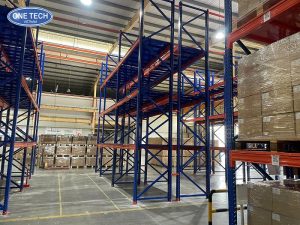
With two pallets stored one behind the other, the pallet positioned at the front must be retrieved first. To access the pallet at the back, the forklift has to move the front pallet out of the way first.
As a result, Double Deep rack naturally tends to operate according to LIFO – Last In, First Out.
If a business places a new batch in front of an older batch, the warehouse can no longer guarantee a strict first-in, first-out sequence.
How to operate Double Deep rack to minimize FIFO/LIFO conflicts
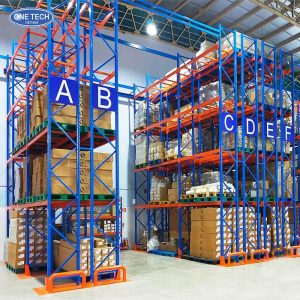
1. Manage inventory by pallet pairs
Pallets with the same SKU, Batch/Lot Number, or similar production dates should be arranged as a pair within the same Double Deep storage position.
Example:
- Pallet A: Lot 01
- Pallet B: Lot 01
In this case, both pallets are treated as a single storage unit belonging to the same batch. This minimizes the risk of a newer pallet being placed in front of an older one.
2. Empty the position before loading a new batch
This is one of the most important operating principles.
If a Double Deep storage position contains two pallets from the same batch, both pallets should preferably be dispatched before a new batch is loaded into that position.
Instead of:
Old batch → New batch → Old batch
the operation should follow:
Old batch → Completely dispatched → Empty position → New batch loaded
This approach helps prevent older inventory from becoming trapped behind newer pallets.
5. Important considerations when implementing Double Deep rack for electronics warehouses
Invest in specialized forklifts – Reach Trucks
A suitable Reach Truck should be used rather than a conventional forklift. The forks must be appropriately sized to reach the second pallet, and operators should receive proper training to minimize the risk of collisions with the rack structure.
Maintain consistent pallet quality
Electronics warehouses often use plastic pallets or export-grade wooden pallets. Pallets must have a strong and stable structure and should not be warped or damaged. A defective pallet can become stuck inside the rack and create difficulties when the forklift attempts to retrieve it.
Control dust and electrostatic discharge (ESD)
Electronic components are highly sensitive to environmental conditions. The warehouse floor where the Double Deep rack system is installed may require ESD-resistant flooring, along with regular cleaning and maintenance of the rack system to minimize dust accumulation around electronic components.
Clearly label storage locations
Because warehouse personnel cannot directly see the second pallet when it is positioned behind the first one, barcodes or RFID tags should be used to identify storage locations. Labels can be positioned on the side of the beam or at an accessible location rather than relying solely on the front-facing position of the rack.
Conclusion
Investing in Double Deep rack is an investment in long-term warehouse efficiency. Although the system may require a higher initial investment and stricter operating discipline, it can significantly reduce warehouse space requirements – an increasingly important cost factor across today's supply chain.
To ensure successful implementation, businesses should consider working with professional warehouse rack suppliers and consultants such as One Tech Rack, who can conduct an on-site assessment and develop a suitable rack solution based on the actual warehouse layout, storage requirements, and operational needs.
With proper planning, Double Deep rack can help businesses optimize warehouse space, increase storage density, and build a more efficient and systematic inventory management system.