

SKU is a term frequently mentioned in sales, inventory management, and warehouse operations. However, not everyone fully understands what an SKU is , what an SKU code means, and how it's used in product management. Therefore, this article summarizes all the information related to SKUs. Check it out!
What is an SKU?
An SKU (Stock Keeping Unit) is a code used to identify and manage each product individually in a warehouse or store. Each SKU typically represents a specific product based on characteristics such as product name, size, color, version, etc.
For example: A store might have laundry detergent of the same brand but in 2L and 3L bottles. These two products would be assigned two different SKUs for easier quantity and storage management.
- Laundry detergent 2L -> SKU is: NG-2L
- Laundry detergent 3L -> SKU is: NG-3L

What is an SKU code used for?
After understanding what an SKU is, let's explore its uses:
- Product identification and differentiation : Each product is assigned a unique code for easy identification and to avoid confusion.
- Inventory management : SKUs help accurately track the quantity of each item currently in stock.
- Tracking incoming and outgoing goods: Based on SKU codes, businesses can control the process of receiving and shipping goods.
- Locating goods: With SKUs combined with warehouse layout diagrams, staff can quickly identify the location of goods.
- Inventory management support: Inventory counting becomes faster and more accurate when each product has an SKU code.
- Minimize errors during order picking: Staff can rely on SKUs to select the correct product, size, or version.
- Optimize warehouse organization: Classify goods by SKU, allowing businesses to arrange products scientifically on each shelf level.
- Software-based management support: SKUs can be integrated with inventory management software for rapid data updates.

The structure of an SKU code
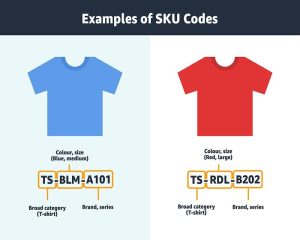
SKU codes are typically constructed from various basic pieces of information that help businesses easily identify and categorize products. Depending on the size and specifics of the industry, businesses can establish their own appropriate SKU code rules.
A typical SKU (Specialized Unit of Storage) code usually includes: Product name or group; Brand; Color; Size; Version or product feature.
Additionally, it should be noted that SKU codes should be arranged in order from general information to detailed information.
Example: SKU Code: KED-TR-120-WH
- KED: Product group – shelving.
- TR: White.
- 120 : Product dimensions, for example, a length of 120 cm.
- WH: A designation for a product version or feature, as defined by the company.
Thanks to this structure, employees can look at the SKU code and quickly identify products, while also conveniently arranging goods by position on the warehouse shelves.
How to set up SKUs effectively
- Establish a standardized coding system so that all products in the warehouse are coded according to a clear, consistent, and easily manageable structure.
- Use easily understandable and memorable characters, prioritizing letters and numbers directly related to the product name, group, or characteristics.
- Avoid using overly long SKU codes, as concise codes are easier for staff to read, remember, and more convenient for data entry or retrieval.
- Avoid using special characters to prevent confusion or errors when entering SKU codes in the inventory management software.
- The order of information in an SKU, such as product group, brand, size, color, and version, is determined to ensure consistency when assigning codes.
- Do not use one SKU for multiple different products because each product or product variant needs a unique code for accurate inventory tracking.
- Develop scalable code so that businesses can easily add new products, sizes, or versions as they go through the business process.
- By associating SKUs with storage locations, businesses can easily manage products by aisle, level, and compartment within their warehouse shelving system.
Distinguish SKUs from other types of codes.
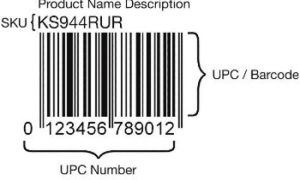
Many people often confuse or misunderstand the difference between SKU and other product codes such as Barcode, UPC, EAN, or Serial Number. Therefore, please refer to the following distinction table:
|
Code type |
Concept |
Purpose of use |
Characteristic |
|
SKU |
Each product has its own unique management code assigned by the business. |
Manage products, inventory, and shelf placement. |
It can be customized and is flexible to meet management needs. |
|
Barcode |
Barcodes are used to encode product information in the form of lines or squares. |
Scan and identify products using a barcode reader. |
It is often printed on packaging and can be used in retail. |
|
UPC |
Standard product codes are commonly used in the US and Canadian markets. |
Product identification within retail and payment systems. |
It has a standard structure, usually consisting of 12 digits. |
|
EAN |
International product codes are widely used globally. |
Product identification and sales management support. |
Commonly known as EAN-13, which consists of 13 digits. |
|
Serial Number |
A unique identification number is assigned to each specific product or device. |
Track each product in terms of warranty, maintenance, and asset management. |
Each product typically has a unique serial number, which is not duplicated. |
The role of SKUs when selecting warehouse shelving.
When building a warehouse, the number and characteristics of SKUs are among the factors businesses need to consider in order to choose the appropriate type of shelving , size, and layout.
- Number of SKUs: The more SKUs a warehouse has, the more storage space is needed, which in turn affects the number and scale of the shelving system.
- Product dimensions: The dimensions of each SKU determine the width, depth, and spacing between shelf levels.
- Weight of goods: SKUs with a large weight require the use of shelving with appropriate load capacities, such as medium-duty or heavy-duty shelving.
- Frequency of import/export: SKUs with a high import/export frequency should be placed in easily accessible locations to shorten pickup time.
- Product characteristics: Goods in cartons, on pallets, small or large items will be suitable for different racking systems.
- SKU scalability: If your business frequently adds new products, you should choose a shelving system that is scalable and allows for flexible positioning.

Frequently Asked Questions about SKUs
Question 1 : Does each product need a unique SKU?
Yes, each product or variant differing in size, color, and design should be assigned a separate SKU for accurate management.
Question 2 : Are SKUs required to follow any specific standards?
No, businesses can create their own SKU rules based on product characteristics, product size, and inventory management needs.
Question 3: Can SKUs be changed?
Yes, but businesses should limit changes to SKUs to avoid impacting inventory data, import/export history, and inventory management systems.
Question 4: Should SKU codes be attached to warehouse shelves?
Businesses can combine SKU codes with row, shelf, and compartment location codes to make it easier for employees to identify storage locations and retrieve goods.
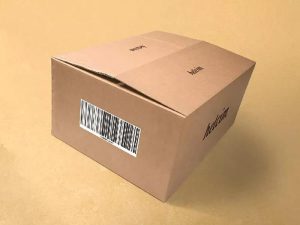
Based on the information above, we hope you now understand what SKUs are and their role in identifying, classifying, and managing goods. Building a scientific SKU system not only helps with accurate inventory control but also supports goods organization, storage location identification, and the selection of suitable warehouse shelving systems. This is one of the key factors that helps businesses optimize space and improve warehouse operational efficiency.